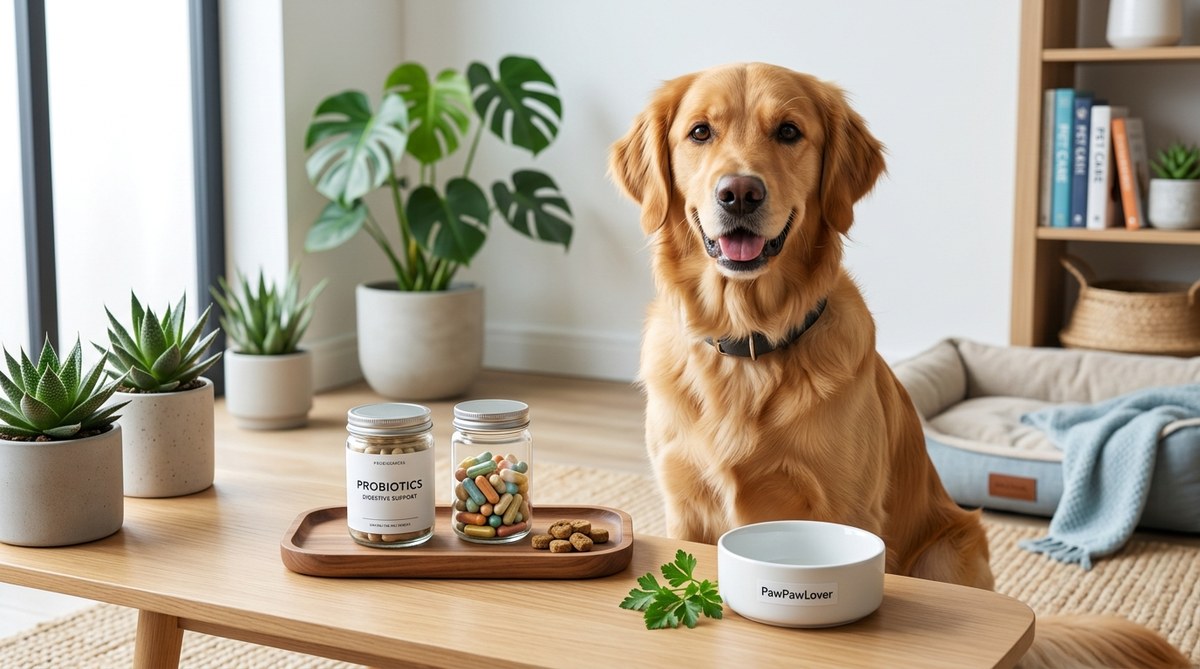
</script></p> <p>Your dog’s tail wags a little less these days. Maybe you’ve noticed soft stools after meals, a gassy evening on the couch, or that “dog breath” that just won’t quit. You’re not alone. More owners than ever are searching for the best probiotics for dogs 2026 to help their pups feel better from the inside out. The market has exploded with powders, chews, and even food toppers. But not all probiotics are created equal. Some work wonders. Others are just expensive snacks. Let’s cut through the noise so you can choose a supplement that actually helps your dog’s gut health.</p> <div style="border:1px solid #c8b88a; background:#fbf7ea; padding:20px; border-radius:14px; margin-bottom:30px;"> <div style="font-weight:700; margin-bottom:10px; color:#856404;">Key Takeaway</div> <p style="margin:0;">The best probiotic for dogs in 2026 is one that matches your dog’s specific symptoms and lifestyle. Look for multiple well-researched strains (especially <em>Bacillus coagulans</em> and <em>Enterococcus faecium</em>), a CFU count between 5 and 20 billion per serving, and a format your dog will tolerate. Synbiotics (probiotics plus prebiotics) offer added benefits. Always check for third-party quality seals like NASC. Skip any product that lists “proprietary blend” without individual amounts.</p> </div> <p>## How to Know if Your Dog Needs a Probiotic</p> <p>Signs of gut imbalance can be subtle. Many owners first notice changes in their dog’s digestion or energy. Here are common red flags that a probiotic might help:</p> <p>– Frequent loose stools or diarrhea that isn’t caused by infection<br /> – Chronic constipation or straining<br /> – Excessive gas or bloating after meals<br /> – Licking paws or scratching more than usual (often linked to gut health)<br /> – Bad breath despite regular dental care<br /> – A dull coat or dry, flaky skin</p> <p>If your dog has recently finished a round of antibiotics, the gut microbiome can take a hit. Probiotics help repopulate good bacteria. Puppies, senior dogs, and breeds prone to digestive issues (like French Bulldogs or German Shepherds) also tend to benefit.</p> <p>But here’s the most important rule: **always rule out serious conditions first**. If your dog has bloody stool, vomiting, or sudden weight loss, see your veterinarian before adding any supplement.</p> <p>## 5 Steps to Choosing the Best Probiotics for Dogs in 2026</p> <p>Follow these practical steps to narrow down your options. Use them as a checklist when comparing labels.</p> <p>1. **Consult your vet.** A quick phone call or exam can identify underlying issues. Your vet may also recommend a specific strain for your dog’s condition (e.g., *E. faecium* for antibiotic-associated diarrhea).<br /> 2. **Check the strain diversity.** Single-strain products can work, but multi-strain formulas tend to support a wider range of gut functions. Look for at least two to four proven strains.<br /> 3. **Count the CFUs.** Colony-forming units (CFUs) measure live bacteria. For most dogs, 5 to 20 billion CFUs per serving is a solid range. Tiny dogs may need less; giant breeds may need more.<br /> 4. **Confirm the delivery format.** Powders are easiest to mix into wet food. Chews are convenient but often have lower CFUs. Capsules can be hidden in a treat. Choose based on your dog’s preferences.<br /> 5. **Verify quality and stability.** The bacteria must survive stomach acid and shelf life. Look for spore-forming strains (like *Bacillus coagulans*), refrigerated products when possible, and a third-party seal (NASC, USP, or NSF).</p> <p>## Comparing Key Probiotic Strains for Dogs</p> <p>Not all bacteria are the same. The table below shows the most common strains found in high-quality dog probiotics in 2026 and what they help with.</p> <p>| Strain | Primary Benefit | Best For | Survival in Stomach |<br /> |——–|—————-|———-|———————|<br /> | *Enterococcus faecium* | Reduces diarrhea, supports immune function | Antibiotic recovery, stress-related loose stools | Moderate (some strains survive well) |<br /> | *Bacillus coagulans* | Survives stomach acid, supports gut barrier | Long-term daily use, sensitive stomachs | Excellent (spore-forming) |<br /> | *Lactobacillus acidophilus* | Breaks down lactose, produces lactic acid | General digestion support | Low (needs protection) |<br /> | *Bifidobacterium animalis* | Balances gut microbiota, reduces inflammation | Allergy-prone dogs, skin health | Moderate |<br /> | *Lactobacillus plantarum* | Produces antioxidants, helps nutrient absorption | Dogs with food sensitivities | Low to moderate |</p> <p>> **Expert advice:** “A multi-strain synbiotic that includes a prebiotic (like inulin or FOS) often outperforms single-strain probiotics. The prebiotic feeds the good bacteria, so they actually colonize the gut. I recommend owners look for products combining *Bacillus coagulans* with a prebiotic for everyday use.” — Dr. Patricia Nguyen, DVM, ACVN resident</p> <p>## Common Mistakes Dog Owners Make When Buying Probiotics</p> <p>The internet is full of recommendations, but many products fall short. Here’s what to avoid:</p> <p>– **Buying based on price alone.** Cheap probiotics often contain too few live bacteria or strains without research.<br /> – **Ignoring the expiration date.** Probiotics are live organisms. Old or improperly stored bottles lose potency.<br /> – **Choosing a “proprietary blend” without listed amounts.** You have no idea how much of each strain you’re getting.<br /> – **Switching brands too fast.** Gut healing takes time. Give a product at least 4 to 6 weeks before judging results.<br /> – **Assuming all “natural” labels are equal.** Natural doesn’t mean effective. Look for clinical studies on the specific strains.</p> <p>## Powder vs. Chew vs. Capsule: Which Format Wins in 2026?</p> <p>Each format has trade-offs. Your dog’s personality and your daily routine will guide you.</p> <p>– **Powders** are the most flexible. You can sprinkle them over food, and they often have higher CFUs. Some require refrigeration after opening.<br /> – **Chewable tablets or soft chews** are travel-friendly and taste like treats. But many chewables have lower CFU counts (2 to 5 billion) because of manufacturing constraints.<br /> – **Capsules** can be hidden in a piece of cheese or pill pocket. They protect bacteria from stomach acid better than some chews, but not all dogs will swallow them.</p> <p>**Our 2026 recommendation:** Start with a powder that lists at least 10 billion CFUs and contains a prebiotic. If your dog refuses the taste, switch to a high-quality chew.</p> <p>## The Rise of Synbiotics in 2026</p> <p>The biggest trend in canine gut health this year is the synbiotic. A synbiotic combines probiotics (good bacteria) with prebiotics (food for those bacteria). Some also include postbiotics (beneficial compounds produced by bacteria). This three-in-one approach targets multiple points of the digestive system.</p> <p>Why does it matter? A standalone probiotic may pass through the gut without colonizing. A prebiotic helps the bacteria stick around. Postbiotics can support the immune system and even oral health. If you want the most complete support for your dog, a synbiotic is worth the investment.</p> <p>A complete guide on choosing the right dog food in 2026 can help you pair a synbiotic with a gut-friendly diet.</p> <p>## Connecting Gut Health to the Rest of Your Dog’s Wellbeing</p> <p>A healthy gut doesn’t just mean firm stools. It influences the immune system, skin condition, mood, and even weight management. Many owners report that after starting a quality probiotic, their dog’s seasonal allergies improve, paw licking stops, and energy levels balance out.</p> <p>If your dog is on a homemade diet, probiotics can help compensate for any nutritional gaps. Check out these essential tips for creating a balanced homemade dog food diet to ensure meals are complete.</p> <p>For dogs with sensitive stomachs, probiotic-rich foods like plain yogurt (if tolerated) or fermented vegetables can be a natural addition. Just be careful with dairy; many dogs are lactose intolerant.</p> <p>## Choosing Between Brands: What the Labels Really Say</p> <p>When you stand in the pet store aisle or scroll through online listings, the labels can feel overwhelming. Here’s a quick decoding guide:</p> <p>– **Guaranteed analysis** lists minimum CFUs. Ignore “minimum at time of manufacture” — you want “minimum at expiration.”<br /> – **Strain naming** should be scientific (e.g., *Lactobacillus acidophilus* LA-5). Generic names like “probiotic blend” are red flags.<br /> – **Storage instructions** matter. If it says “refrigerate after opening,” but you travel often, consider a shelf-stable spore-based product.<br /> – **Third-party seals** are your best friend. NASC certification means the facility passed a GMP audit. Some brands also use independent lab testing for potency.</p> <p>## A Quick Checklist Before You Buy</p> <p>Print this or keep it handy:</p> <p>– [ ] Consulted with a veterinarian<br /> – [ ] Identified specific symptoms (diarrhea, gas, allergies)<br /> – [ ] Checked CFU count: 5 to 20 billion per serving<br /> – [ ] Reviewed strains: at least 2 to 5 well-studied strains<br /> – [ ] Looked for prebiotic or synbiotic formula<br /> – [ ] Verified third-party quality seal (NASC, USP)<br /> – [ ] Confirmed expiration date and storage instructions<br /> – [ ] Considered format: powder preferred over chew</p> <p>## Your Dog’s Gut Health Journey Starts Today</p> <p>You don’t need to feel overwhelmed by the choices. The best probiotics for dogs 2026 are the ones that fit your dog’s unique needs, your budget, and your lifestyle. Start with a conversation with your vet. Then use the steps and checklist above to compare products with confidence.</p> <p>Your dog’s happier tail wags, better digestion, and brighter eyes are worth the effort. Give the probiotic time to work — at least a month — and monitor changes. You might be surprised how much a healthy gut can improve your pup’s whole life.</p> <p>For more ways to support your dog’s wellbeing, read our guide on essential nutritional tips to keep your dog healthy and happy. And if you enjoy making treats at home, these healthy homemade dog treats your pet will love can be a fun way to reward your dog while keeping ingredients clean.</p> </div><!-- .shadow-entry-content --> <div class="entry-meta"> <span class="byline">By : <span class="author vcard"><a class="url fn n" href="https://pawpawlover.com/author/harper/">harper</a></span></span><span class="posted-on"><a href="https://pawpawlover.com/how-to-choose-the-best-probiotics-for-your-dogs-gut-health-in-2026/" rel="bookmark"><time class="entry-date published updated" datetime="2026-06-10T21:05:28+01:00">10 June 2026</time></a></span><span class="cat-links"><ul class="post-categories"> <li><a href="https://pawpawlover.com/category/dog-nutrition/" rel="category tag">Dog Nutrition</a></li></ul></span> </div><!-- .entry-meta --> </div><!-- .shadow-entry-container --> </article><!-- #post-64 --> </div> <nav class="navigation post-navigation" aria-label="Posts"> <h2 class="screen-reader-text">Post navigation</h2> <div class="nav-links"><div class="nav-previous"><a href="https://pawpawlover.com/what-every-dog-owner-should-know-about-grain-free-diets/" rel="prev"><svg width="24" height="24" aria-hidden="true" role="img" focusable="false" xmlns="http://www.w3.org/2000/svg" viewBox="0 0 24 24"><path d="M10 17l5-5-5-5v10z"></path><path fill="none" d="M0 24V0h24v24H0z"></path></svg><span>What Every Dog Owner Should Know About Grain-Free Diets</span></a></div><div class="nav-next"><a href="https://pawpawlover.com/5-essential-nutrients-often-missing-in-commercial-dog-food/" rel="next"><span>5 Essential Nutrients Often Missing in Commercial Dog Food</span><svg width="24" height="24" aria-hidden="true" role="img" focusable="false" xmlns="http://www.w3.org/2000/svg" viewBox="0 0 24 24"><path d="M10 17l5-5-5-5v10z"></path><path fill="none" d="M0 24V0h24v24H0z"></path></svg></a></div></div> </nav> <div id="comments" class="comments-area"> <div id="respond" class="comment-respond"> <h3 id="reply-title" class="comment-reply-title">Leave a Reply <small><a rel="nofollow" id="cancel-comment-reply-link" href="/how-to-choose-the-best-probiotics-for-your-dogs-gut-health-in-2026/#respond" style="display:none;">Cancel reply</a></small></h3><form action="https://pawpawlover.com/wp-comments-post.php" method="post" id="commentform" class="comment-form" novalidate><p class="comment-notes"><span id="email-notes">Your email address will not be published.</span> <span class="required-field-message">Required fields are marked <span class="required">*</span></span></p><p class="comment-form-comment"><label for="comment">Comment <span class="required">*</span></label> <textarea id="comment" name="comment" cols="45" rows="8" maxlength="65525" required></textarea></p><p class="comment-form-author"><label for="author">Name <span class="required">*</span></label> <input id="author" name="author" type="text" value="" size="30" maxlength="245" autocomplete="name" required /></p> <p class="comment-form-email"><label for="email">Email <span class="required">*</span></label> <input id="email" name="email" type="email" value="" size="30" maxlength="100" aria-describedby="email-notes" autocomplete="email" required /></p> <p class="comment-form-url"><label for="url">Website</label> <input id="url" name="url" type="url" value="" size="30" maxlength="200" autocomplete="url" /></p> <p class="comment-form-cookies-consent"><input id="wp-comment-cookies-consent" name="wp-comment-cookies-consent" type="checkbox" value="yes" /> <label for="wp-comment-cookies-consent">Save my name, email, and website in this browser for the next time I comment.</label></p> <p class="form-submit"><input name="submit" type="submit" id="submit" class="submit" value="Post Comment" /> <input type='hidden' name='comment_post_ID' value='64' id='comment_post_ID' /> <input type='hidden' name='comment_parent' id='comment_parent' value='0' /> </p></form> </div><!-- #respond --> </div><!-- #comments --> </main><!-- #main --> </div><!-- #primary --> <aside id="secondary" class="widget-area" role="complementary"> <section id="block-2" class="widget widget_block widget_search "><form role="search" method="get" action="https://pawpawlover.com/" class="wp-block-search__button-outside wp-block-search__text-button wp-block-search" ><label class="wp-block-search__label" for="wp-block-search__input-1" >Search</label><div class="wp-block-search__inside-wrapper " ><input class="wp-block-search__input" id="wp-block-search__input-1" placeholder="" value="" type="search" name="s" required /><button aria-label="Search" class="wp-block-search__button wp-element-button" type="submit" >Search</button></div></form></section><section id="block-3" class="widget widget_block "><div class="wp-block-group"><div class="wp-block-group__inner-container is-layout-flow wp-block-group-is-layout-flow"><h2 class="wp-block-heading">Recent Posts</h2><ul class="wp-block-latest-posts__list wp-block-latest-posts"><li><a class="wp-block-latest-posts__post-title" href="https://pawpawlover.com/how-to-boost-your-dogs-joint-health-with-the-right-foods-in-2026/">How to Boost Your Dog’s Joint Health with the Right Foods in 2026</a></li> <li><a class="wp-block-latest-posts__post-title" href="https://pawpawlover.com/how-to-spot-hidden-fillers-in-your-dogs-kibble-in-2026/">How to Spot Hidden Fillers in Your Dog’s Kibble in 2026</a></li> <li><a class="wp-block-latest-posts__post-title" href="https://pawpawlover.com/what-breed-specific-nutrition-really-means-for-your-dogs-health/">What Breed-Specific Nutrition Really Means for Your Dog’s Health</a></li> <li><a class="wp-block-latest-posts__post-title" href="https://pawpawlover.com/5-essential-tips-for-transitioning-your-dog-to-a-new-food-safely/">5 Essential Tips for Transitioning Your Dog to a New Food Safely</a></li> <li><a class="wp-block-latest-posts__post-title" href="https://pawpawlover.com/how-to-calculate-your-dogs-daily-calorie-needs-for-weight-management/">How to Calculate Your Dog’s Daily Calorie Needs for Weight Management</a></li> </ul></div></div></section><section id="block-5" class="widget widget_block "><div class="wp-block-group"><div class="wp-block-group__inner-container is-layout-flow wp-block-group-is-layout-flow"><h2 class="wp-block-heading">Archives</h2><ul class="wp-block-archives-list wp-block-archives"> <li><a href='https://pawpawlover.com/2026/07/'>July 2026</a></li> <li><a href='https://pawpawlover.com/2026/06/'>June 2026</a></li> <li><a href='https://pawpawlover.com/2026/05/'>May 2026</a></li> </ul></div></div></section><section id="block-6" class="widget widget_block "><div class="wp-block-group"><div class="wp-block-group__inner-container is-layout-flow wp-block-group-is-layout-flow"><h2 class="wp-block-heading">Categories</h2><ul class="wp-block-categories-list wp-block-categories"> <li class="cat-item cat-item-5"><a href="https://pawpawlover.com/category/diy-care/">DIY Care</a> </li> <li class="cat-item cat-item-3"><a href="https://pawpawlover.com/category/dog-nutrition/">Dog Nutrition</a> </li> <li class="cat-item cat-item-6"><a href="https://pawpawlover.com/category/dog-recipes/">Dog Recipes</a> </li> <li class="cat-item cat-item-4"><a href="https://pawpawlover.com/category/pet-grooming/">Pet Grooming</a> </li> <li class="cat-item cat-item-8"><a href="https://pawpawlover.com/category/pet-health/">Pet Health</a> </li> <li class="cat-item cat-item-7"><a href="https://pawpawlover.com/category/puppy-care/">Puppy Care</a> </li> </ul></div></div></section></aside><!-- #secondary --> </div><!-- #inner-content-wrapper--> </div><!-- #content --> <footer id="colophon" class="site-footer" role="contentinfo"> <div class="wrapper"> <!-- supports column-1, column-2, column-3 and column-4 --> <!-- supports unequal-width and equal-width --> <div class="site-info clear column-1"> <!-- supports column-1 and column-2 --> <span> </span> </div><!-- .site-info --> </div> </footer><!-- #colophon --> <div class="popup-overlay"></div> <div class="totop"><svg width="24" height="24" aria-hidden="true" role="img" focusable="false" xmlns="http://www.w3.org/2000/svg" viewBox="0 0 24 24"><path d="M7.41 8.59L12 13.17l4.59-4.58L18 10l-6 6-6-6 1.41-1.41z"></path><path fill="none" d="M0 0h24v24H0V0z"></path></svg></div> </div><!-- #page --> <script type="text/javascript" src="https://pawpawlover.com/wp-content/themes/storyo/assets/js/slick.js?ver=20151215" id="slick-jquery-js"></script> <script type="text/javascript" src="https://pawpawlover.com/wp-includes/js/imagesloaded.min.js?ver=5.0.0" id="imagesloaded-js"></script> <script type="text/javascript" src="https://pawpawlover.com/wp-content/themes/storyo/assets/js/packery.pkgd.min.js?ver=20151215" id="jquery-packer-js"></script> <script type="text/javascript" src="https://pawpawlover.com/wp-content/themes/storyo/assets/js/jquery-matchHeight.js?ver=20151215" id="jquery-matchHeight-js"></script> <script type="text/javascript" src="https://pawpawlover.com/wp-content/themes/storyo/assets/js/theia-sticky-sidebar.js?ver=6.7.1" id="jquery-theia-sticky-sidebar-js"></script> <script type="text/javascript" src="https://pawpawlover.com/wp-content/themes/storyo/assets/js/navigation.js?ver=20151215" id="storyo-navigation-js"></script> <script type="text/javascript" src="https://pawpawlover.com/wp-content/themes/storyo/assets/js/skip-link-focus-fix.js?ver=20151215" id="storyo-skip-link-focus-fix-js"></script> <script type="text/javascript" src="https://pawpawlover.com/wp-content/themes/storyo/assets/js/custom.js?ver=20151215" id="storyo-custom-js"></script> <script type="text/javascript" src="https://pawpawlover.com/wp-includes/js/comment-reply.min.js?ver=6.7.1" id="comment-reply-js" async="async" data-wp-strategy="async"></script> </body> </html>